
GEO · AI Search Visibility
Generative Engine
OptimizationIncluding the part I got wrong.

GEO is getting your brand named when AI assistants answer questions. Most of it is the SEO you should already be doing. The part that is actually new is not on your site at all, and I spent a few months telling people otherwise.
What GEO actually is
The short version, before anything else.
Generative engine optimization is the work of getting your brand named, correctly and with attribution, when AI systems answer questions: ChatGPT, Perplexity, Google's AI Overviews, Claude. Buyers increasingly get an answer instead of ten blue links, and GEO decides whether you are in it. Most of the work is the SEO you should already be doing. The part that is genuinely new is off your site, in what the open web says about you.
Score your brand
Ten questions, honest scoring, and a fix list in priority order. No email, no pitch.
Ten questions. No email required.
0 of 10 answered- Off-site presencecounts double
1.Do real people discuss your brand in places you do not own?
Reddit threads, Discord servers, forums, Slack communities. Your own posts do not count.
2.Does your brand appear in third-party comparison or "best of" lists?
Roundups, directories, and comparison posts published by someone other than you.
3.Has a publication quoted or named your brand in the last 12 months?
Trade press, newsletters, podcasts, or an industry blog. A press release you distributed does not count.
4.Do you publish first-party data other people cite?
A study, a survey, benchmark numbers, or original research with your name on it.
- Pages worth citing
5.Do your key pages answer the question in the first 100 words?
Before the brand story, the preamble, or the scroll-jacking hero.
6.Do your pages carry specific, checkable facts?
Names, numbers, dates, prices, and sources rather than adjectives.
7.Do you have FAQ sections phrased the way buyers actually ask?
Real question wording, not keyword-stuffed headers.
8.Can a crawler read your content without a login or JavaScript?
Gated PDFs, login walls, and client-only rendering are invisible to most AI crawlers.
- Measurement
9.Can you see AI assistant referrals as their own channel in analytics?
ChatGPT, Perplexity, Claude, and Copilot arriving as a segment you can actually report on.
10.Have you asked the assistants your category’s buying questions and logged the answers?
Running the actual prompts a buyer would run, and recording which brands came back.
Why it matters now
Four numbers, each tied to one named source.
year-over-year growth in referral traffic from AI platforms
Aggregated AI search statistics, 2026 →Where I was wrong
April 2026, published under my own name.
In April I wrote GEO vs SEO: Same Thing, Baby, and I even wrote a song to make the point stick. The song holds up. Step 3 of the checklist under it does not. It told you to drop an llms.txt file at your root and called it ten minutes well spent.
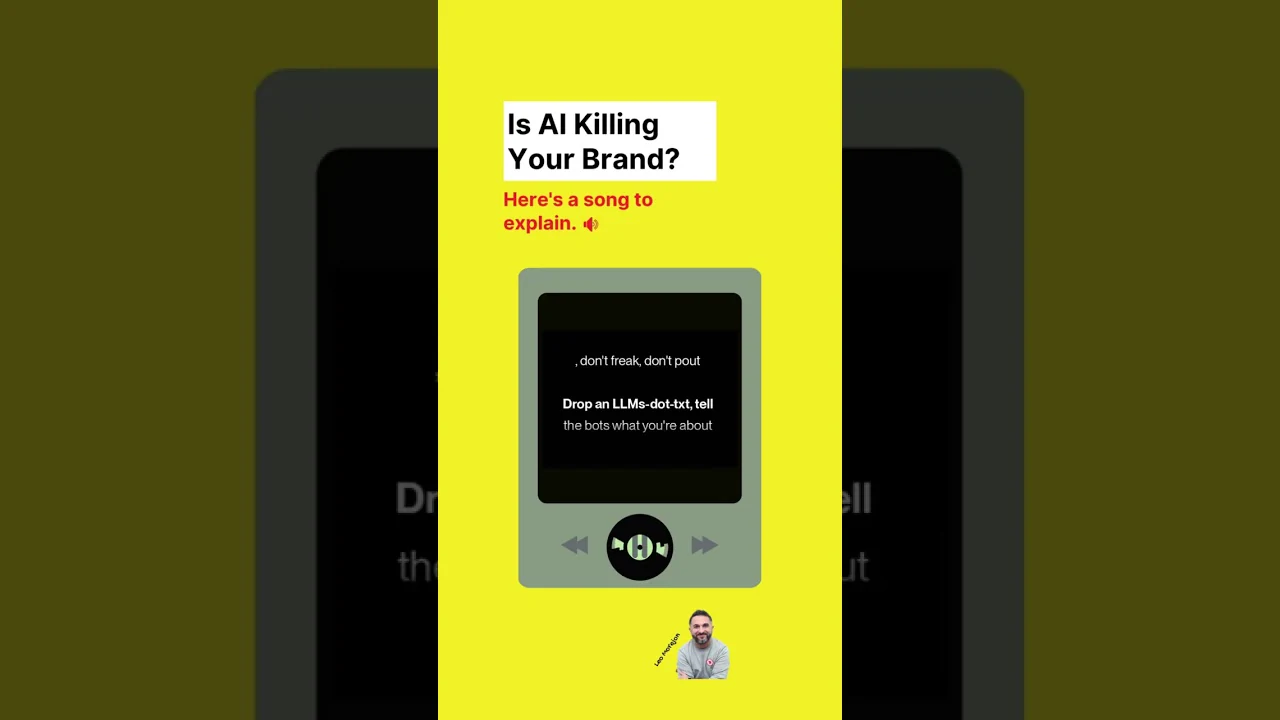
I put it in the song
Drop an LLMs-dot-txt, tell the bots what you’re about.
What I wrote in April
Drop a small text file at /llms.txt that summarizes your site and tells AI crawlers what your content is for. Takes ten minutes to write. Worth it.
What the logs showed
Across more than 500 million AI bot events, GPTBot, ClaudeBot, and PerplexityBot skip the file and crawl the HTML instead. Google's John Mueller compared it to the keywords meta tag. Ten minutes, no return.
What actually works
The new work is off your site, which is inconvenient for everyone selling on-site checklists.
Ahrefs studied 75,000 brands and found the strongest predictor of appearing in an AI answer was branded mentions on sites you do not control. Tinuiti tracked citations across seven assistants and nine categories and watched Reddit's share grow 73 percent in four months. Assistants are not rewarding brands for posting on Reddit; they are treating long-running conversations between real people as independent evidence, which is exactly what a brand page is not.
That reframes the job. Your pages still have to be worth quoting once something points at them, so the on-site work stays. But the thing that gets you named is the footprint you have earned everywhere else.
Off-site mentions
Earn conversation in the threads, lists, and publications assistants treat as independent evidence. Publish data other people quote.
Slowest to build. Decides whether you get named at all.
Pages worth quoting
Answer the question in the first hundred words. Carry checkable facts. Stay readable without a login or JavaScript.
This is the SEO you should already be doing.
Honest measurement
Track the traffic assistants actually send you, and log your buying-intent prompts monthly as a trend rather than a ranking.
The only GEO number that survives scrutiny.
The file checklist
llms.txt, sitemap conventions, and the rest of the ten-minute tasks that get sold as GEO deliverables.
The crawlers do not fetch it. I used to recommend this.
- Community threadsHeaviest
Reddit, Discord, forums. Long-running conversations read as independent evidence.
- Third-party listsHeavy
"Best of" roundups, comparisons, and directories you do not control.
- Press and cited dataHeavy
Earned coverage, and original numbers other people quote.
- Your own pagesNecessary, not sufficient
Still required. It is what gets quoted once something else points here.
Weighting reflects Ahrefs' study of 75,000 brands, which found off-site branded mentions the strongest predictor of appearing in AI answers, and Tinuiti's citation tracking. These are directional, not percentages of a citation budget.
Measuring it honestly
Most GEO dashboards are selling weather reports.
Rand Fishkin ran 600 volunteers through identical prompts across Claude, ChatGPT, and Google, and fewer than 1 in 100 runs returned the same brands. Non-determinism, caching, personalization, and location all move the answer. So a tool that tells you that you rank third in ChatGPT this week is reporting noise, confidently.
What is real: the traffic assistants actually send you, visible as its own channel in analytics. It is small today, growing at triple digits, and it converts well above organic. Track that, plus a monthly log of your buying-intent prompts read as a trend rather than a ranking. If something cannot be measured, I will say so instead of inventing a dashboard for it.
My receipts
From my own Search Console and GA4, on this site.
Google Search impressions on a single catalog page of mine in the last six months, a big share of them the long, full-sentence queries AI assistants send when they research an answer.
A distinct traffic channel in my own GA4. ChatGPT, Perplexity, and friends send this site visitors today, and I can see which pages they land on.
My case studies are built as primary sources with quotable spans and citation blocks, so when AI systems retell the Oreo Blackout Tweet story, the attribution chain points here.
The catalog page in question: 424 AI Marketing Case Studies. The primary-source example: the Oreo Blackout Tweet, from someone who was in the room.
How to work with me
Audit first. Everything else is optional and I will tell you when it is not worth it.
AI visibility audit
Fixed scope, two to three weeks. Where assistants mention you today, where your mention footprint is thin compared to the brands that do get named, and a prioritized 90-day plan. You get the findings and the plan whether or not we work together after.
Ongoing advisory
Monthly. I work with your team on the off-site program, review what is shipping, and keep the measurement honest as the surfaces change. For teams that have the plan and want a second set of eyes while they run it.
Team workshop
Half day, remote or in person. I taught MarTech as an adjunct at Iowa State and West Virginia, and this is that format: your team leaves able to run the audit themselves instead of buying it again next year.
What I do not sell: guaranteed placements in ChatGPT, a per-prompt ranking dashboard, or done-for-you content at volume. The first two do not work and the third is not what I am good at.
Questions people ask about GEO
GEO is the work of getting your brand named and cited when AI systems answer questions: ChatGPT, Perplexity, Google AI Overviews, Claude, Copilot. Same goal as SEO, different judges. The mechanics overlap with SEO heavily on your own site. The part that is genuinely new sits off your site, in the mentions and conversations these models treat as independent evidence.
Mostly no on your own site, and I wrote a whole piece saying so. Clean structure, specific answers, crawlable pages: that was the SEO playbook already. The real difference is that AI assistants weight what the open web says about you more heavily than search rankings did. So the new work looks more like PR and community presence than technical SEO.
No, and I used to say yes. Server-log analysis covering more than 500 million AI bot events found that GPTBot, ClaudeBot, and PerplexityBot almost never fetch it, and Google has said no Search system reads it. Search Engine Land found 8 of 9 sites saw no measurable change after adding one. It takes ten minutes, so add it if you like, but do not count it as GEO work.
Three layers, in this order of impact. Off-site: earn mentions in the threads, lists, and publications that assistants treat as independent evidence, and publish first-party data other people cite. On-site: make your pages answer the question in the first hundred words, carry checkable facts, and stay readable without a login or JavaScript. Measurement: track AI referral traffic as its own channel and run your buying-intent prompts monthly as a directional trend.
No, and nobody honest can. Rand Fishkin ran 600 volunteers through identical prompts and found fewer than 1 in 100 runs returned the same brands, because of non-determinism, caching, personalization, and location. Anyone selling you a guaranteed ChatGPT ranking is selling a number they cannot control. What I can do is raise the odds across the whole distribution and measure what actually arrives.
By watching what AI assistants actually send you rather than what they say about you on any given run. AI referral traffic as its own analytics channel, assistant-shaped queries in Search Console, and a monthly log of your buying-intent prompts read as a trend line rather than a ranking. Small numbers today, growing fast, and they convert well above organic.
Close enough in practice. Answer engine optimization usually refers to getting picked up by featured snippets and answer boxes; generative engine optimization refers to being named inside a generated answer. The work overlaps almost entirely, and the vocabulary tends to track whoever is selling it. Do not pay extra for the acronym.
The audit is fixed scope and fixed price; I quote the number on the first call once I know how many properties and markets are involved. Advisory is monthly. Workshops are a flat day rate. No retainers that renew silently, and no percentage-of-spend arrangements.
Want to know if AI search mentions you?
Start with the scorecard above. If you want the full picture across your properties, ask me for the audit. You get the findings and the plan either way.
Start a Conversation →