It’s Easier Than Ever to Break an AI Rule You Didn’t Know About
Marketing job descriptions ask for AI now. So does almost every marketer I talk to. What nobody hands you is the rulebook. So I built Alignment Machine, a weekly newsletter with a free library behind it, and this is how I check every answer in it.
Too much, too hard, too fast.
- The rules come from regulators, state laws, court decisions and every platform’s own help pages
- The originals are written for lawyers. The summaries often cite rules you can’t find.
- They change week to week, sometimes faster
- And it’s getting harder to tell what’s real from what’s slop
Seven checks, every issue.
One email a week, plus a free library you can search without signing up: AI rules and a platform guide. Every issue runs the same seven checks. Tap one.
Check 01
“Does this need an AI label?”
When an ad, post, chatbot or cloned voice has to say AI made it.
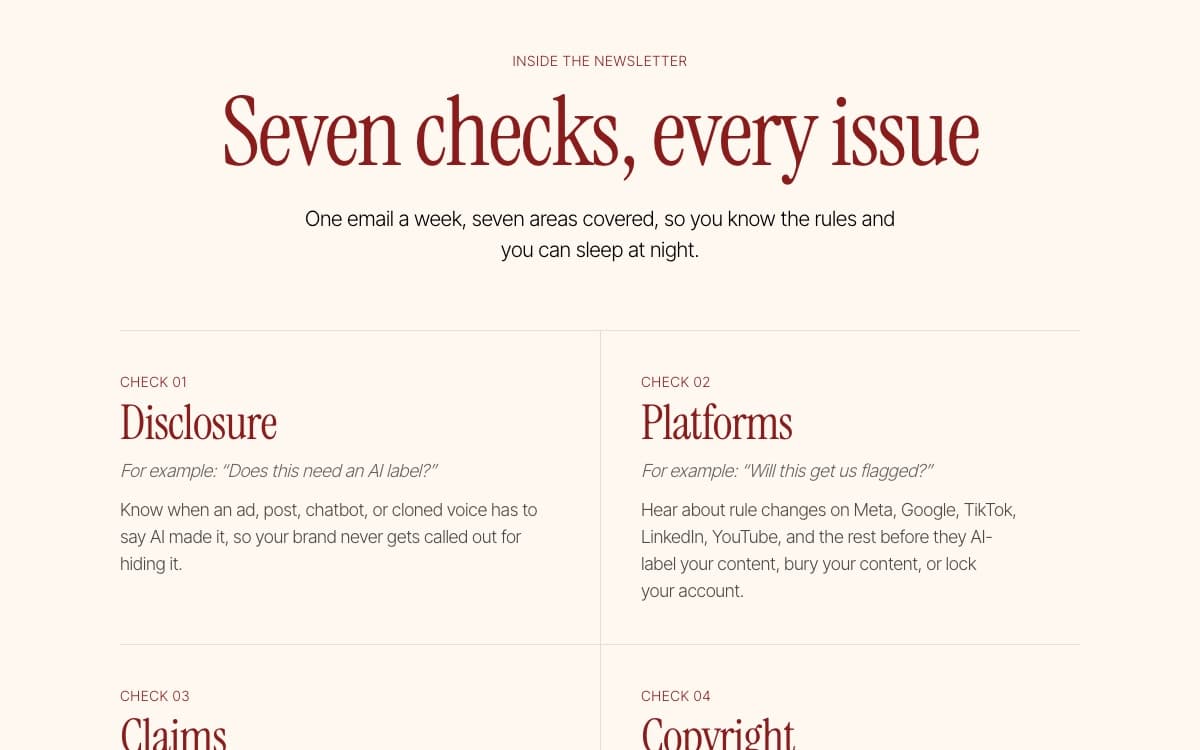
One AI writes. A different one checks.
I build with AI every day, so I know exactly how confidently it can be wrong. That’s why the system that drafts an answer never gets to grade its own homework. Click through the four steps.
Start at the rule
The regulator, the statute, the court decision, or the platform’s own policy page. Never somebody’s summary of it.
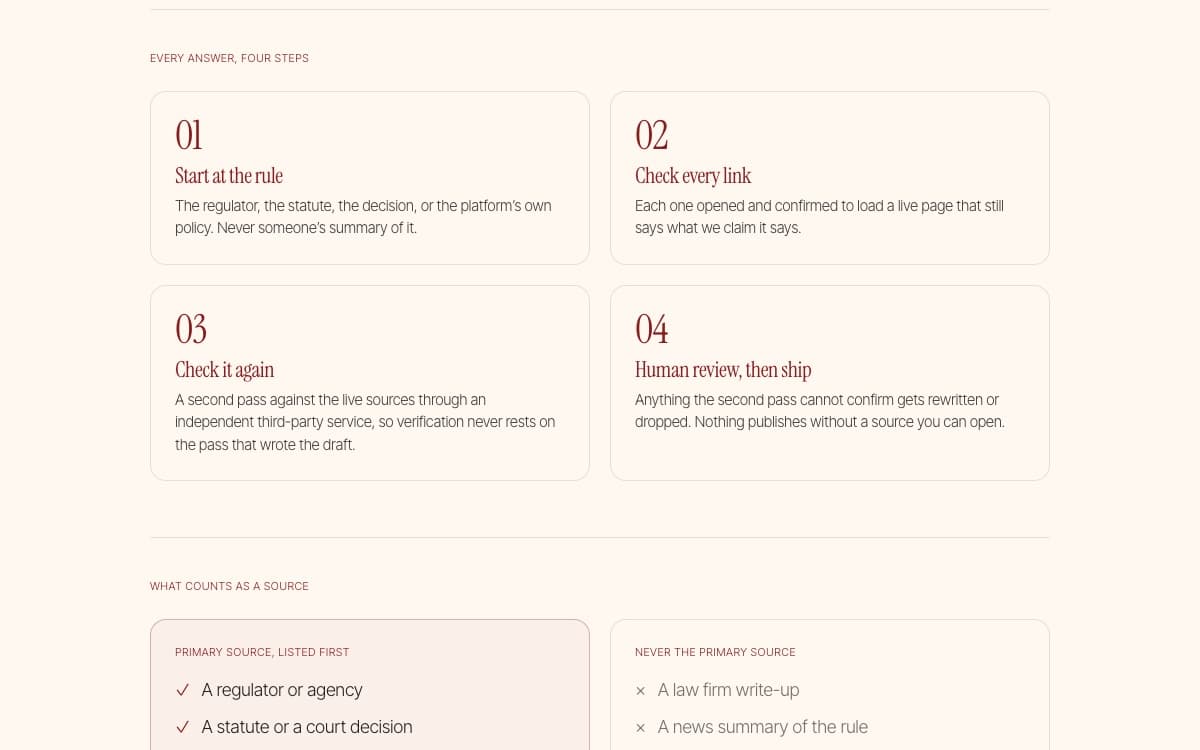
A summary of a rule isn’t the rule.
Every answer leads with a primary source. Law firm write-ups and news stories can point the way, but they never get to be the source. Try it: which of these would make the cut?
- The FTC’s own guidance page
- A law firm’s client alert about the rule
- YouTube’s help page on AI disclosure
- A news story about the new law
- The text of the statute itself
- An SEO blog post listing “AI rules for 2026”
0 of 6 answered
Every answer shows its work.
- The answer, in plain language, up top
- What it means for your marketing, in one line
- The primary source, listed first, linked
- The date the links were last checked
So when someone in legal (or your boss, or your client) asks “says who?”, you send them the link.
In one week, 4 of 44 answers moved.
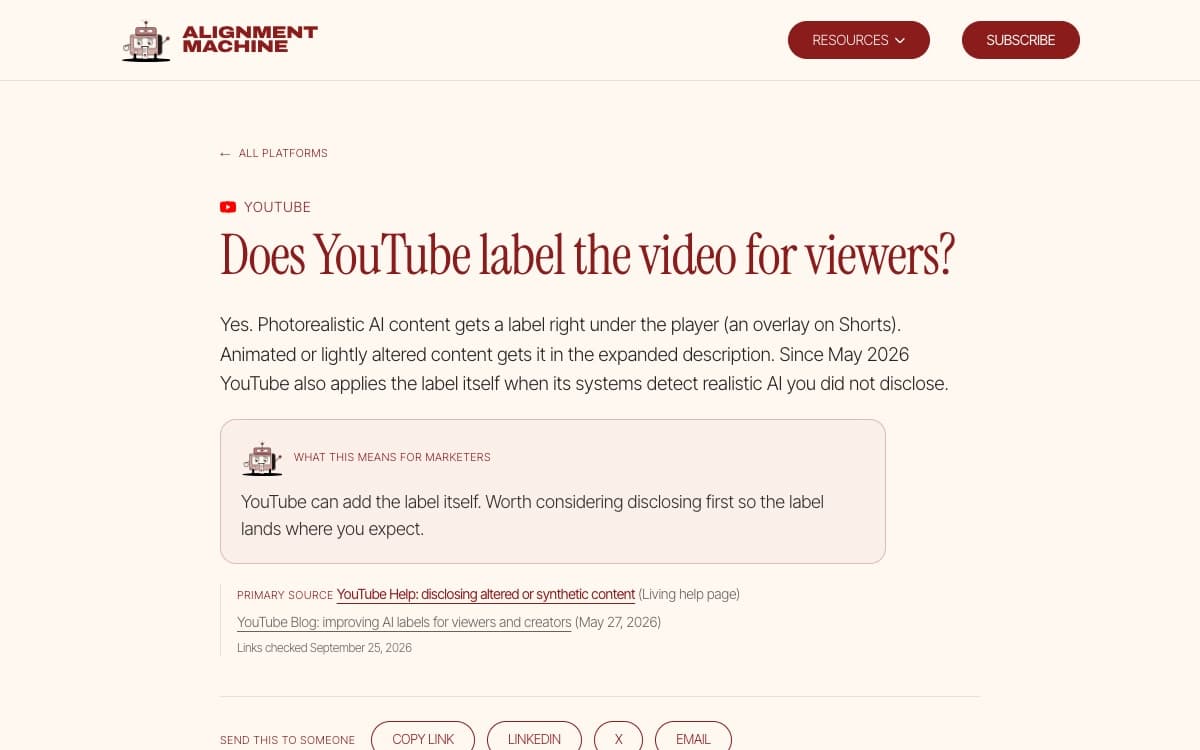
On September 25, 2026, the weekly check re-opened all 44 answers in the library. Four had drifted. One was this YouTube answer, which was right when I wrote it and wrong by the time YouTube changed its labels. Another was a Sora API shutdown date that had already passed. Flip it:
“Does YouTube label the video for viewers?”
Photorealistic AI content gets a label right under the player (an overlay on Shorts). Animated or lightly altered content gets it in the expanded description. YouTube can also apply the label itself when its systems detect realistic AI you did not disclose.
What changed it: YouTube’s May 27, 2026 post on AI labels and its help page.
Who labels what.
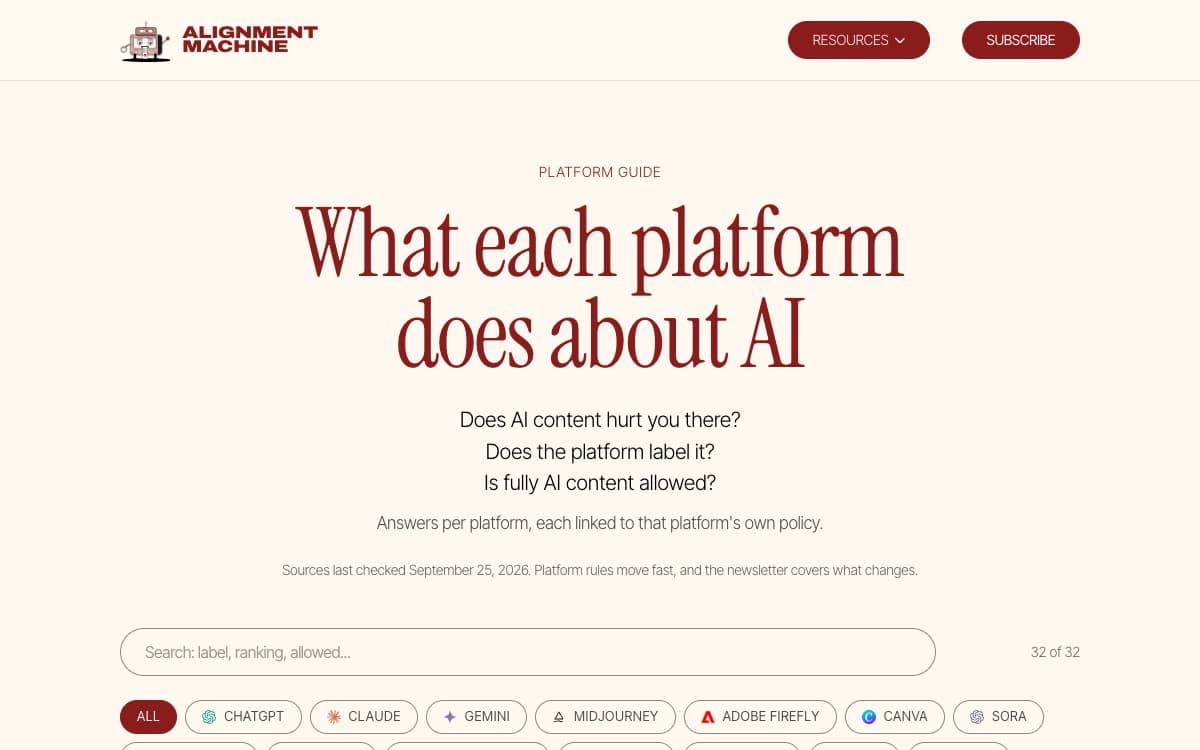
The AI question marketers search for most is some version of “will this get an AI label?” Short answers below. Each one links to the full answer and its source.
Instagram & Facebook
Meta labels images it detects as AI-made. Edited photos can get tagged too.
Full answer →
YouTube
Realistic AI gets a label under the player, and YouTube can add it for you.
Full answer →
TikTok
Realistic AI has to be labeled, and TikTok often labels it before you do.
Full answer →
Checked means checked on that date.
- A rule can change the morning after the check. The date tells you how fresh the answer is; it doesn’t freeze the rule.
- If I get something wrong, the correction runs in the next issue instead of a quiet edit
- Every answer page has a way to report a mistake
- No lawyer reviews any of this. Which brings me to the box below.
Get the checked version weekly.
One email a week on what changed and what it means for your marketing work. Five minutes. Free.
Subscribe to Alignment MachineAlready past the rules and onto the rollout? See how real brands are using AI, build a starting point with the free AI policy generator, or read about my AI enablement work. What rule are you least sure about right now?
Quick answers
No. It is marketing research: what the rule says, where it says it, and what it means for the work. If a campaign or an account depends on the answer, take it and its primary source to someone qualified to advise you.
Yes. Meta says it labels images it detects as AI-generated across Facebook, Instagram and Threads, using provenance signals attached to the file. Edited photos can pick up the label too.
Yes. Photorealistic AI content gets a label under the player (an overlay on Shorts), and YouTube can apply it itself when its systems detect realistic AI you did not disclose.
Anyone in marketing, or anyone whose job touches marketing, who wants to use AI without losing track of the rules.

Marketing Strategist & AI Expert